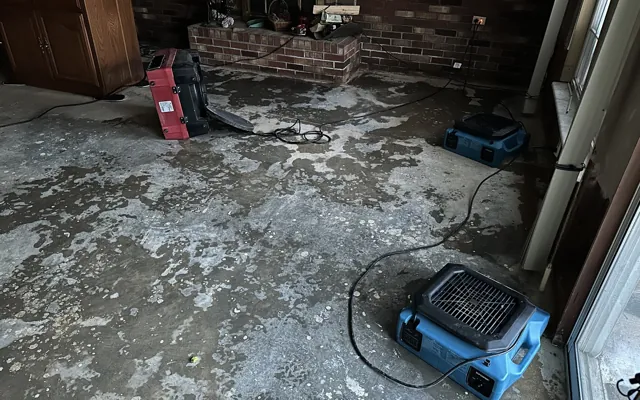
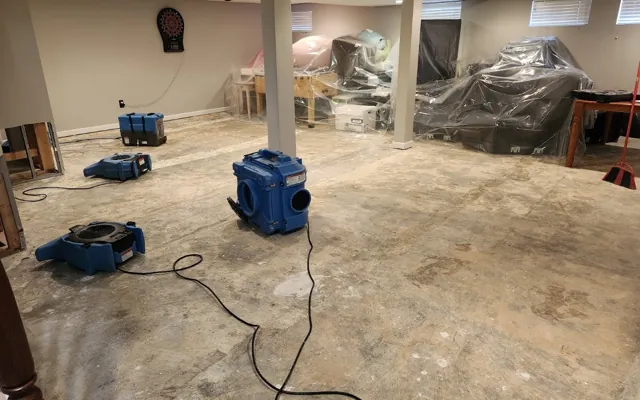
Squirrel Hill's early-1900s houses on steep streets face constant water pressure during heavy rains. The rapid-response crew pumps standing water and dries basements within days.

Truck-mounted and portable pumps remove standing water quickly, starting with the lowest rooms where water pools deepest.
Remaining water is extracted, and mud and unsalvageable materials are removed to allow proper drying.
Industrial air movers and dehumidifiers dry walls, subfloor, and framing with daily moisture checks.

Storm and flood cleanup in Squirrel Hill generally runs $1,500 to $10,000 or more, depending on water depth, how long it sat, and whether flooring, drywall, or mechanical systems need replacement. Standard homeowner's policies typically cover storm-driven water intrusion, though separate flood insurance may apply near the rivers, and crews help clarify which applies.
Squirrel Hill is Pittsburgh's largest neighborhood, a grid of early-1900s homes sending runoff straight at basement walls. Long-buried galvanized lines and clay laterals fail in hard freezes, and seepage happens often here. Steep streets push storm runoff at basement walls. Original galvanized plumbing and cast-iron drains fail in hard freezes, and the combination of winter freeze cracks and spring snowmelt makes this a high-frequency area. From Squirrel Hill, crews also cover nearby Greenfield, Point Breeze, Highland Park, Mount Washington, Shadyside, Wilkinsburg. See every neighborhood and town on the full service area page.
See all areas servedEvery loss is photographed, measured, and logged from the first visit, so the paperwork holds up with your insurance carrier.
Technicians follow recognized IICRC drying standards and prove the work with daily moisture readings, not guesswork.
Emergency dispatch any hour of the day or night, with a real crew on the way, not a callback in the morning.
A real crew dispatched any hour, not a callback in the morning.
Trained technicians following recognized IICRC drying standards.
Truck-mounted, portable, and submersible for any size loss.
The loss is documented and billed to the carrier directly.
The neighborhood's steep terrain and early-1900s housing stock with clay laterals and poor drainage create ideal conditions for water intrusion. Heavy rain that arrives faster than old systems can handle is routine.
Most Squirrel Hill basements dry completely within 4 to 6 days once crews have pumped standing water and established drying.
Crews are on call 24 hours a day and can be on the way to Squirrel Hill within the hour.
Call (412) 866-1481