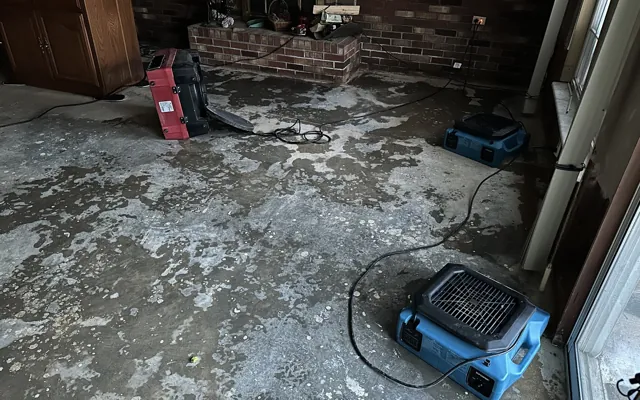
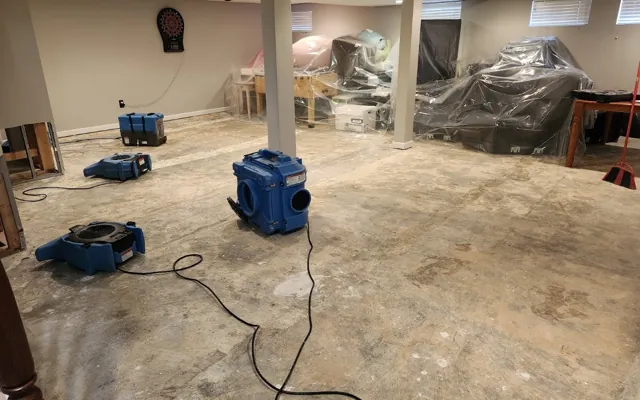
Point Breeze's larger, family-owned homes carry long pipe runs through unheated spaces, prime targets for winter bursts. Crews respond fast, pump thoroughly, dry fully, and keep Point Breeze families in their homes, not displaced.

Multiple pumps work simultaneously to clear standing water from large Point Breeze basements, then portable extractors remove trapped water from beneath flooring and in wall cavities.
Crews lay vapor barriers over remaining wet areas to contain moisture migration, sealing off dry rooms from wet zones to prevent cross-contamination as drying proceeds.
Large Point Breeze homes require extended drying with multiple air movers and commercial dehumidifiers, monitored continuously until all wood framing, insulation, and subfloors read safe.

Storm and flood cleanup in Point Breeze generally runs $1,500 to $10,000 or more, depending on water depth, how long it sat, and whether flooring, drywall, or mechanical systems need replacement. Standard homeowner's policies typically cover storm-driven water intrusion, though separate flood insurance may apply near the rivers, and crews help clarify which applies.
Point Breeze is known for large, older homes on generous lots near Frick Park, many still owned by families who've held them for decades. Big houses mean long pipe runs through unheated crawlspaces, and mature basements here can take on water when a winter thaw arrives faster than the ground absorbs it. Crews know how Point Breeze homes drain and where they leak. Point Breeze's generous lots and mature landscaping accelerate thaw runoff toward basements in spring. Long pipe runs through unheated spaces freeze and split during hard Pittsburgh winters. Larger basement footprints take longer to dry once saturated. From Point Breeze, crews also cover nearby Squirrel Hill, Greenfield, Mount Washington, Highland Park, Wilkinsburg, Regent Square. See every neighborhood and town on the full service area page.
See all areas servedEvery loss is photographed, measured, and logged from the first visit, so the paperwork holds up with your insurance carrier.
Technicians follow recognized IICRC drying standards and prove the work with daily moisture readings, not guesswork.
Emergency dispatch any hour of the day or night, with a real crew on the way, not a callback in the morning.
A real crew dispatched any hour, not a callback in the morning.
Trained technicians following recognized IICRC drying standards.
Truck-mounted, portable, and submersible for any size loss.
The loss is documented and billed to the carrier directly.
Look for water pooling in one area during a freeze cycle, reduced water pressure at fixtures, or sudden spike in your water meter. Check unheated crawlspaces and pipe runs first; copper and PVC can both burst in uninsulated zones during Pittsburgh's hard freezes. If water starts appearing after a freeze ends, a burst was likely the cause.
Large basements hold more standing water and take longer to dry. Ground saturation around Point Breeze's large properties keeps moisture wicking into walls and subflooring even after pumping. Industrial drying takes many days. If damp smell persists, mold may be growing; crews can test and remediate if needed.
Crews are on call 24 hours a day and can be on the way to Point Breeze within the hour.
Call (412) 866-1481