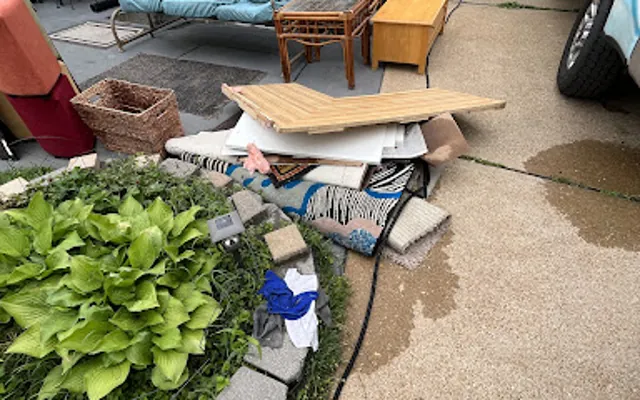
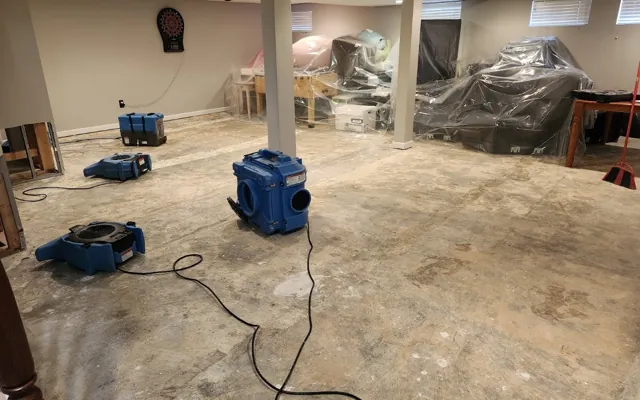
When Pittsburgh freezes hard, Squirrel Hill basements fill fast. Crews respond within hours with trained extraction and structural drying to protect your historic home.

Crews position submersible pumps and deploy extraction crews as soon as the water authority clears the street, moving standing water from your Squirrel Hill basement in hours rather than days to prevent mold and structural damage.
Main break water carries mud and grit that trap moisture for weeks if left behind. Crews remove every trace of sediment from floors and affected surfaces in Squirrel Hill homes so drying progresses without hidden pockets of dampness.
Air movers and dehumidifiers run until moisture levels prove safe, with daily tracking on Squirrel Hill jobs. This step alone often prevents the secondary damage that shows up in walls months after extraction.

Water main break cleanup in Squirrel Hill typically runs $1,500 to $8,000, depending on water volume, sediment and debris, and how much of the basement or crawlspace was affected. Some costs may be recoverable through a municipal claim if the break is confirmed as a city main issue, and crews help document everything either way.
Squirrel Hill's steep hillside grid sits on decades of galvanized pipes and clay laterals buried under homes families have owned for generations. Winter cold reaches into exterior walls and unheated spaces, splitting supply lines overnight, while the neighborhood's signature elevation funnels runoff straight at basement foundations, creating both freeze burst and seepage problems. Squirrel Hill's early-1900s plumbing was never insulated for modern winter severity, and the neighborhood's steep topography means hillside runoff concentrates at basement walls whenever snow melts fast or heavy rain falls. From Squirrel Hill, crews also cover nearby Greenfield, Point Breeze, Highland Park, Mount Washington, Shadyside, Wilkinsburg. See every neighborhood and town on the full service area page.
See all areas servedEvery loss is photographed, measured, and logged from the first visit, so the paperwork holds up with your insurance carrier.
Technicians follow recognized IICRC drying standards and prove the work with daily moisture readings, not guesswork.
Emergency dispatch any hour of the day or night, with a real crew on the way, not a callback in the morning.
A real crew dispatched any hour, not a callback in the morning.
Trained technicians following recognized IICRC drying standards.
Truck-mounted, portable, and submersible for any size loss.
The loss is documented and billed to the carrier directly.
Not typically, since the main break is a municipal responsibility. However, crews document everything so you can file a claim against the city. Many Squirrel Hill residents recover 50 to 80 percent of restoration costs this way, especially if water damaged personal property. Crews help coordinate the claim from day one.
In Squirrel Hill's older homes with finished basements, expect 5 to 10 days of active drying equipment running. Unfinished basements and crawlspaces often finish in 3 to 5 days. Crews track moisture daily, so you know exactly when it's safe to put belongings back.
Crews are on call 24 hours a day and can be on the way to Squirrel Hill within the hour.
Call (412) 866-1481