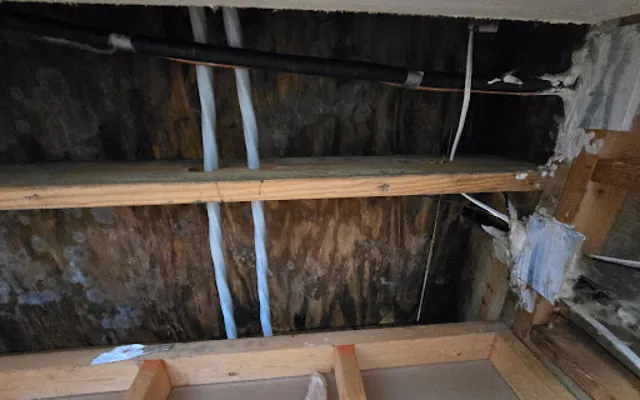
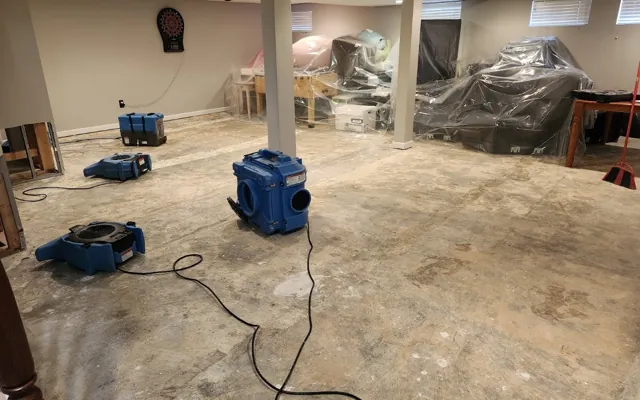
When ice dams form on Squirrel Hill's early-1900s homes, water backs up under shingles and drips into attics and ceilings, so the IICRC crews arrive fast, extract water, dry insulation verified-dry, and remove the backup risk.

Crews check how far water has moved into your Squirrel Hill attic, insulation, and ceiling below to determine drying scope.
Standing water and saturated insulation in the attic are removed to stop damage from spreading further in your Squirrel Hill home.
Air movers and dehumidifiers dry the roof deck, rafters, and any affected ceiling with daily moisture checks until verified-dry.

Ice dam water damage cleanup in Squirrel Hill typically runs $1,200 to $7,000, depending on how much insulation and ceiling area was affected and whether the intrusion happened repeatedly over a long cold stretch. Larger or older roofs with less attic insulation tend toward the higher end. Most homeowner policies cover sudden ice dam damage, and crews document the event for your claim.
Squirrel Hill is one of Pittsburgh's largest neighborhoods, a hillside grid of early-1900s houses that families have owned for decades. Long-buried galvanized supply lines and clay laterals under those older homes do not hold up well to a hard winter freeze or a sudden spring thaw, and steep side streets send runoff straight at basement walls, so seepage and burst-pipe calls turn up here often. Squirrel Hill's early-1900s homes have inadequate attic ventilation and insulation by modern standards, creating perfect conditions for ice dams during freeze-thaw cycles. Steep terrain sends winter melt and spring rain downhill toward foundations. Original plumbing is vulnerable to the region's hard freezes. From Squirrel Hill, crews also cover nearby Greenfield, Point Breeze, Highland Park, Mount Washington, Shadyside, Wilkinsburg. See every neighborhood and town on the full service area page.
See all areas servedEvery loss is photographed, measured, and logged from the first visit, so the paperwork holds up with your insurance carrier.
Technicians follow recognized IICRC drying standards and prove the work with daily moisture readings, not guesswork.
Emergency dispatch any hour of the day or night, with a real crew on the way, not a callback in the morning.
A real crew dispatched any hour, not a callback in the morning.
Trained technicians following recognized IICRC drying standards.
Truck-mounted, portable, and submersible for any size loss.
The loss is documented and billed to the carrier directly.
Squirrel Hill's older homes have poor attic insulation and ventilation compared to modern standards. Warm attic air melts snow on the roof. Cold eaves freeze that meltwater, creating a dam that backs water under the shingles.
Not by itself. The problem is poor attic insulation and ventilation, not the shingles. Adding insulation and improving ventilation prevents ice dams better than new shingles. Gutter heaters can help during a freeze, but the root cause is attic heat loss.
Crews are on call 24 hours a day and can be on the way to Squirrel Hill within the hour.
Call (412) 866-1481